Why Generic AI Fails at Geo Game: Analyzing ohnePixel's Viral Duel
Streamer ohnePixel tried to use Gemini to beat a pro Geo Game player. It didn't go well. Here is why generic LLMs struggle with the game, and how a specialized AI Coach makes the difference.
When popular streamer ohnePixel decided to take on professional Geo Game player Zigzag in a duel, he had a secret weapon: Google Gemini, which he affectionately called "Jenny." The plan was simple—let the AI do the heavy lifting, identify locations, and maybe even pull off an upset victory.
The result? A spectacular failure that perfectly illustrates why generic large language models (LLMs) are terrible at Geo Game, and why specialized AI coaching is the only way to actually improve at the game.
The "Jenny" Experiment: What Went Wrong?
The duel exposed a fundamental truth about AI and Geo Game: general-purpose LLMs like ChatGPT or Gemini are amazing at many tasks, but they lack the game sense and meta knowledge required to excel at Geo Game. They can read text, identify landmarks, and make educated guesses based on general knowledge, but they don't understand the specific, learnable patterns that separate pros from beginners.
Let's break down the specific failures that turned this experiment into a masterclass on what not to do.
Case Study 1: The "Text Trap" (USA vs. UK)
Timestamp: 09:36 in the video.
In Round 5, the AI faced a classic Geo Game scenario: conflicting clues.
-
Visual Evidence: The road had double yellow center lines, a definitive marker for North America (specifically the USA). The landscape featured pine flatwoods and white sandy soil, typical of the Southeastern US.
-
Text Evidence: A street sign read "Wetherington".
The Generic AI's Mistake:
Gemini saw the name "Wetherington," decided it sounded British, and confidently told ohnePixel: "That likely points you to the UK." It completely ignored the road markings and the environment.
The ReverseImageLocation Advantage: Pure Environmental Deduction
We ran the same location through ReverseImageLocation. Unlike the generic model which got distracted by the text, our AI Coach ignored the "British-sounding" name and looked straight at the biomes and geology.
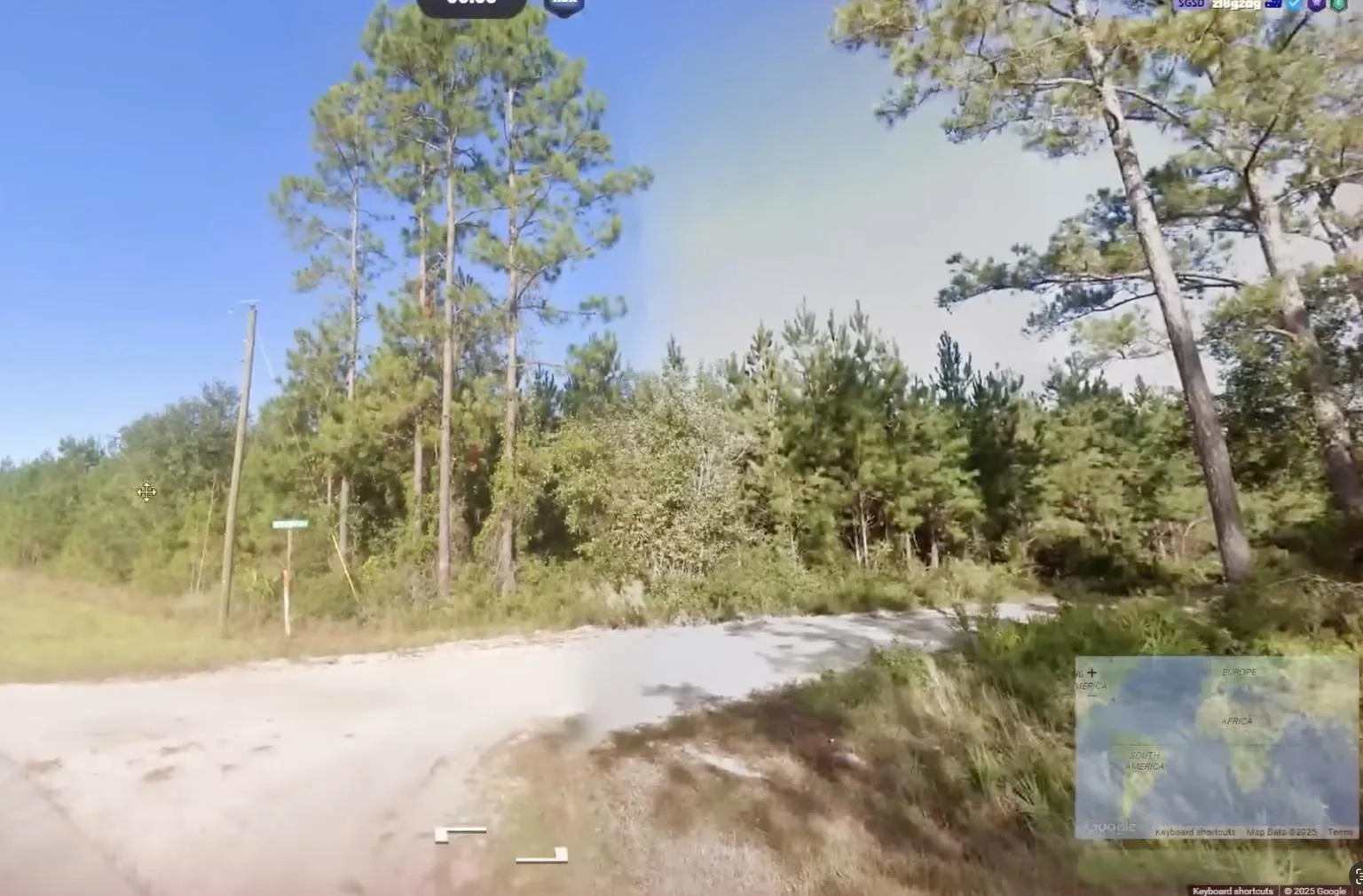
The AI's Analysis:
Decisive Clue: The combination of white sandy dirt roads and tall Southern Yellow Pine forests is the smoking gun. This specific landscape is iconic to the coastal plains of the Southeastern United States, particularly Florida.
Reasoning: While Georgia and the Carolinas have pine forests, their inland soil is often red clay. The pure white sand seen here is most characteristic of Florida (especially the Panhandle) or immediate coastal areas. The completely flat terrain supports this hypothesis.
Most Likely Location: 🇺🇸 United States (Northern Florida / Panhandle)
✅ The Lesson: Geology Trumps Toponymy
This is the difference between a chatbot and a coach. A chatbot reads text. A coach reads the soil. By distinguishing "White Sand" from "Red Clay," ReverseImageLocation correctly identified the Florida Panhandle, avoiding the trap that fooled the generic AI.
Case Study 2: The "Billboard Bait" (Mexico Round)
In another round, the AI found itself in Mexico. It spotted a billboard advertising a university in "La Laguna" and immediately latched onto this text as the primary clue. The AI confidently suggested a location based on the university's name, completely missing the fact that billboards in Mexico often advertise institutions from other states.
What the AI failed to notice:
- Mexican utility poles (distinctive design patterns)
- Topography (specific Mexican landscape features)
- Road infrastructure (Mexican road marking styles)
- Architecture (regional Mexican building patterns)
⚠️ The Lesson: Context Matters
You can't trust every sign you read. Billboards advertise products and services from all over the country. A university billboard doesn't mean you're near that university—it means someone paid to advertise there. Generic AIs don't understand this context. They see text and assume it's location-relevant. A specialized Geo Game coach knows to cross-reference text with infrastructure meta, topography, and other reliable indicators.
Case Study 3: The "Hamburg Süd" Problem
While not explicitly shown in the video, the "Hamburg Süd" shipping container is a classic example of how generic AI gets tricked. When an AI sees a shipping container labeled "Hamburg Süd" (a German port city), it might confidently guess Germany. But experienced Geo Game players know that shipping containers move around the world—that container could be in Kenya, Tanzania, or anywhere else.
🚢 The Lesson: Generic Models Lack Meta Knowledge
Generic LLMs don't understand the specific "meta" knowledge that Geo Game requires. They don't know that shipping containers are mobile and unreliable. They don't know that certain Google car equipment is country-specific. They don't know that camera generation artifacts can pinpoint locations. ReverseImageLocation is specifically trained to know these things—it understands that shipping containers move and are not reliable location markers.
The Missing Link: "Meta" and "Reasoning"
Geo Game isn't just about "what does this look like?" It's about specific, learnable patterns that form the game's "meta" layer:
- Bollards (roadside posts with country-specific designs)
- Utility poles (distinctive patterns by country)
- Car meta (Google Street View car equipment that's country-specific)
- Camera generation artifacts (visual patterns that indicate when and where coverage was captured)
- Infrastructure patterns (road markings, guardrails, signs)
Generic AIs don't understand this meta layer. They approach Geo Game like a general knowledge quiz, trying to match images to their training data. But Geo Game requires specialized knowledge that isn't in general training datasets.
How ReverseImageLocation Solves These Problems
ReverseImageLocation is built differently. It uses a two-step reasoning process that mirrors how pro players think:
-
Clue Analysis: First, it systematically identifies and lists all available clues—meta, infrastructure, environment, language, and more. It doesn't jump to conclusions.
-
Location Inference: Then, it weighs these clues, cross-references them, and makes a reasoned decision. It understands which clues are reliable (like car meta) and which are misleading (like shipping container labels).
🎯 The ReverseImageLocation Difference
✅ What ReverseImageLocation Does Right:
- Prioritizes meta clues (car equipment, camera generation) over text
- Understands that text can be misleading and cross-references it with infrastructure
- Knows that shipping containers, billboards, and other mobile objects are unreliable
- Uses a systematic two-step process: analyze clues first, then infer location
- Is specifically trained on Geo Game Meta knowledge
❌ What Generic AI Does Wrong:
- Over-indexes on text (OCR) and treats it as primary evidence
- Lacks context about misleading signs and billboards
- Doesn't understand mobile objects (shipping containers) are unreliable
- Makes snap judgments without systematic clue analysis
- Relies on general knowledge rather than specialized Geo Game Meta
Why This Matters
The ohnePixel experiment isn't just entertaining—it's educational. It shows that AI can be a powerful tool, but only if it's trained for the specific task. A general-purpose chatbot can help you write emails or answer trivia questions, but it can't teach you Geo Game strategy. It doesn't understand the game's unique requirements.
ReverseImageLocation is different because it's built specifically for Geo Game. It understands the meta, knows which clues to trust, and teaches you the systematic approach that separates pros from beginners. It doesn't just guess—it reasons, explains, and educates.
Conclusion: Don't Rely on a Chatbot to Win Your Games
ohnePixel's experiment with "Jenny" was a disaster, but it was also a masterclass in what happens when you try to use the wrong tool for the job. Generic AI is amazing at many things, but Geo Game requires specialized knowledge and reasoning that only comes from dedicated training.
Use a dedicated Coach to learn the skills. Try ReverseImageLocation for free today and see the difference. Our AI Coach will teach you the meta, help you understand which clues to trust, and guide you through the systematic reasoning process that wins games.
Don't let a chatbot lead you to the wrong continent. Learn from a coach that understands the game.
Tools, Guides, and Articles for This Topic
Move from reading into action with the most relevant solver pages, learnable meta guides, and supporting articles.
Use our advanced GeoGuessr solver for NMPZ, rural rounds, and hard snapshots. Built for players who need deep meta reasoning, not just a broad GeoGuessr AI overview.
Explore the complete GeoGuessr AI hub for ai geoguessr, geoguesser ai, and geoguessr ai solver searches. Compare tools, learn the meta, and pick the best workflow.
Looking for a Picarta alternative? Compare accuracy, reasoning transparency, and hard-case performance when Picarta-style matching struggles on generic or low-context images.
Master Google Street View car meta for GeoGuessr. Identify countries by snorkels, roof racks, tape, mirrors, antennas, camera generations, and car blur.
Master the most reliable meta in Geo Games. A complete guide to identifying countries by their traffic bollards.
A deep dive comparing ReverseImageLocation with Picarta, GeoSpy, and ChatGPT to see which tool is best for Geo Game players who want to learn, not just win.
We took Rainbolt's most legendary 0.1-second guesses and ran them through our AI Coach. The results reveal the science behind the magic. This is how he wins.